Solar Mounting Structure Wind Loads: Why Location and Building Height Matter
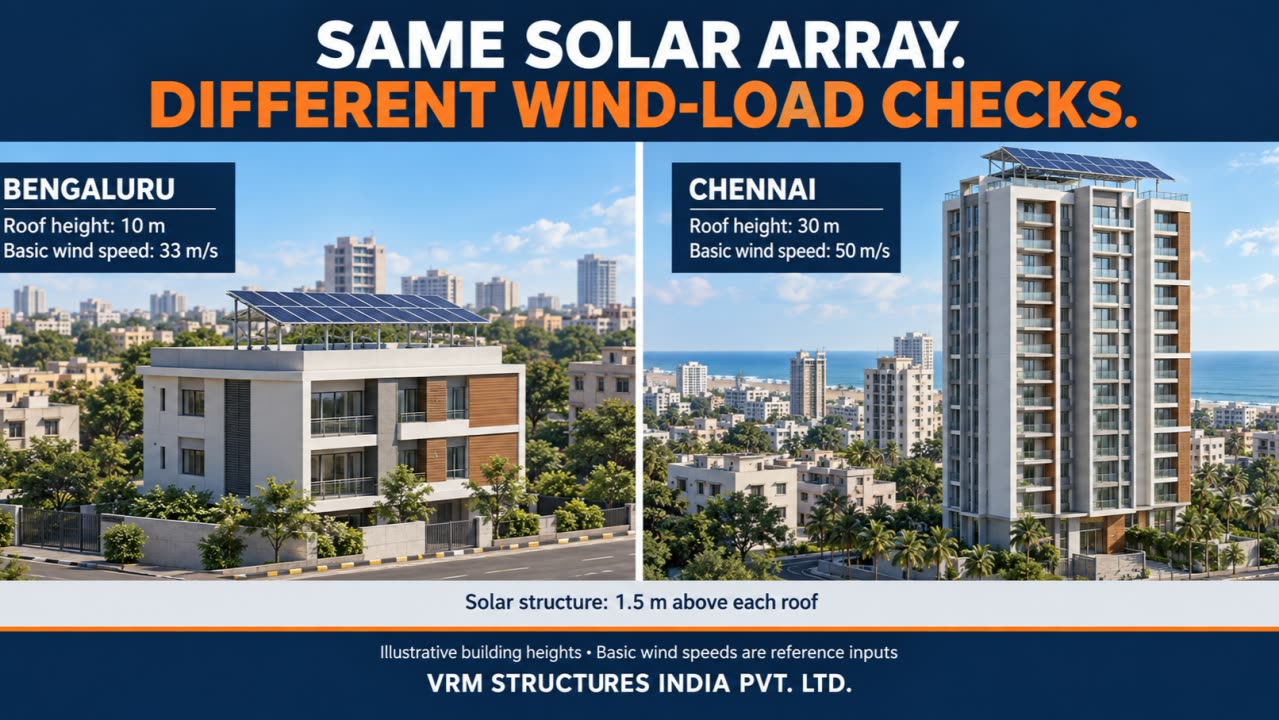
Same solar modules. Same mounting layout. Two different rooftops.
Can we use the same mounting structure without reviewing the design?
Consider two illustrative rooftop solar installations:
Site A — Bengaluru, Karnataka
- Building roof height above ground: 10 metres
- Solar structure height above roof: 1.5 metres
- Reference basic wind speed: 33 m/s ≈ 119 km/h
Site B — Chennai, Tamil Nadu
- Building roof height above ground: 30 metres
- Solar structure height above roof: 1.5 metres
- Reference basic wind speed: 50 m/s = 180 km/h
Both installations use identical module sizes, tilt angles and array layouts.
Same solar array. Different locations. Different building heights. Different wind-load checks.
The building heights are illustrative. Basic wind speeds are reference inputs; final design loads depend on the actual site conditions and applicable design factors.
The cities and reference wind speeds are real. The building heights are assumed for this comparison.
The same solar capacity does not mean the same structural loading.
First Difference: Geographical Location
Chennai and Bengaluru have different reference basic wind speeds.
Importantly, basic wind speed is a starting point for structural design—not the final wind speed at the solar array.
Wind pressure varies with the square of wind speed.
If all other factors were equal, comparing 50 m/s with 33 m/s gives:
(50 ÷ 33)² ≈ 2.30
That means the wind-pressure component based on basic speed alone is approximately 2.3 times higher for the Chennai reference.
This does not mean the completed Chennai installation has exactly 2.3 times the wind load. Height, terrain, topography, pressure coefficients and other applicable design factors must also be considered.
Second Difference: Building Height
A structure mounted 1.5 metres above a roof is not necessarily a low-height installation.
At Site A, it sits above a roof already 10 metres above ground.
At Site B, it sits above a roof 30 metres above ground.
The roof elevation matters—not just the solar structure’s leg height.
Wind-speed assessment depends on height and surrounding terrain. For a given terrain category, wind speeds generally increase with height.
The engineer must therefore assess the relevant height of the installation above ground rather than considering only its height above the roof.
Third Difference: Exposure and Roof Position
Building height and city name still do not provide the complete answer.
An installation surrounded by dense development can have different exposure from one facing open terrain.
Arrays near roof edges and corners may experience different suction from arrays farther inside the roof.
Module tilt, clearance, parapets and array geometry can also influence the loading assessment.
These details must be evaluated for the actual site.
What Can Change in the Mounting Structure?
A site-specific assessment may lead to changes in:
- Purlin and rafter profiles.
- Support spacing and overhangs.
- Bracing arrangements.
- Bolt and cleat connections.
- Base plates and anchors.
- Roof attachment locations and supporting-member checks.
The outcome should come from calculations, rather than simply adding more steel.
What Should EPC Companies Provide?
Before requesting a mounting-structure quotation, share:
- Exact site location.
- Roof height above ground.
- Solar array height above the roof.
- Roof dimensions, type and supporting structure.
- Surrounding terrain and exposure.
- Module dimensions, tilt and layout.
- Distance from roof edges and relevant parapet details.
A quotation prepared without these inputs may not address the actual installation conditions.
“Designed for 180 km/h” needs context.
For which location, building height, terrain, array configuration and anchoring arrangement?
A stated wind-speed rating becomes meaningful when its design assumptions are clear.
Same modules. Different location. Different height. A fresh engineering check.
When requesting a solar mounting structure, do you provide the building height—or only the project capacity?
First published on LinkedIn. Join the discussion there.

Sign up to receive structure specifications.
By subscribing you agree to with our Privacy Policy and provide consent to receive updates from our company.
© 2026 VRM STRUCTURES INDIA PRIVATE LIMITED. All rights reserved.