Solar Mounting Structure Connections: Why Bolts, Cleats and Anchors Matter
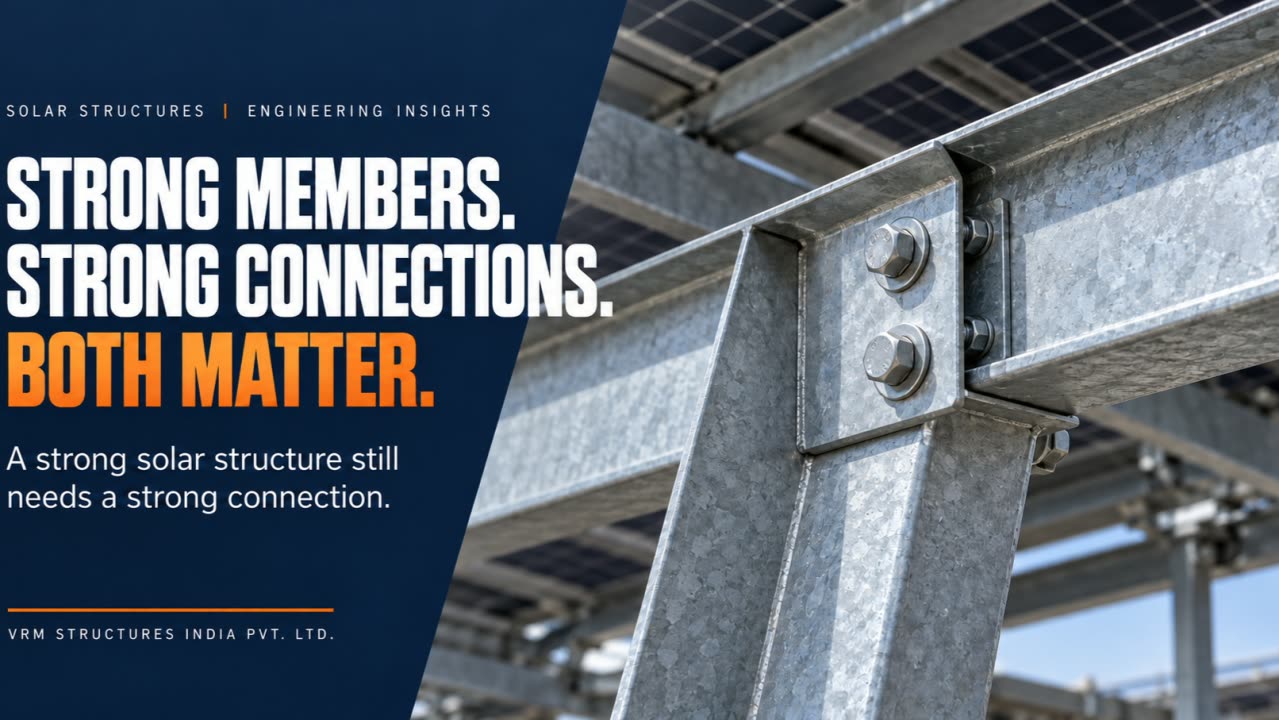
A Strong Solar Structure Still Needs a Strong Connection
Strong steel members are essential. So are the connections that hold them together.
When comparing solar mounting structures, buyers often focus on steel thickness, profile dimensions, material grade and total weight.
These factors matter. But they do not tell the complete story.
Solar mounting structure connections must safely transfer the forces acting on the system. A substantial purlin or column cannot compensate for an inadequately designed cleat, bolt arrangement or anchor.
Why Connections Matter in Solar Mounting Systems
Wind creates uplift and lateral forces on solar installations.
These forces travel through module attachments, purlins, rafters, bracing and columns into the supporting roof or foundation. The exact route depends on the structural arrangement.
Engineers call this the load path.
Every connection along that path must transfer its intended forces. Checking individual steel members is only part of verifying the complete mounting system.
1. Module Clamps and Mounting Bolts
The connection between the solar module and its supporting structure deserves careful attention.
Clamps and mounting bolts must suit the module frame and comply with the manufacturer’s installation requirements, including:
- Permitted mounting locations.
- Clamp dimensions and engagement.
- Approved mounting arrangements.
- Specified tightening requirements.
A strong supporting structure cannot correct an unsuitable module attachment.
2. Purlin and Rafter Bolted Connections
Bolt diameter alone does not establish connection capacity.
A bolted connection also depends on bolt grade, quantity, hole dimensions, spacing, edge distance and the thickness and strength of the connected material.
A stronger bolt does not automatically prevent the surrounding steel from tearing or deforming.
The bolt and the connected components must be evaluated together.
3. Cleats and Bracing Connections
Cleats transfer forces between structural members. Bracing helps stabilise the mounting structure and transfer lateral forces.
Both require properly designed connections.
Plate thickness, connection geometry, bolt placement and weld details—where applicable—affect their performance.
Bracing cannot perform its intended role if its end connections cannot transfer the required forces.
4. Base Plates and Solar Structure Anchoring
Structural verification continues beyond the steel frame.
For a concrete-supported installation, relevant checks include base plate dimensions, plate bending, welds, anchor forces, embedment, concrete strength and edge distances.
For rooftop installations, the attachment and the supporting roof components must also be checked.
A substantial column still needs an adequately designed connection to its support.
Installation Quality Completes the Design
An engineered connection must be installed according to the approved details.
Before project handover, verify that:
- Specified bolts, nuts and washers have been used.
- Tightening follows the prescribed procedure.
- Connection geometry matches the approved drawings.
- Alignment issues have been resolved before fastening.
- Changes to holes, cleats or anchors have received engineering approval.
A connection that looks neat is not necessarily a connection that has been verified.
Related Reading: Engineering Beyond Steel Weight
Connection design is part of a broader principle: solar mounting structures must be evaluated beyond material weight alone.
In our earlier article, Solar Mounting Structures Need Engineering Beyond kg, we explain why section geometry, support spacing, bracing and anchoring matter when assessing a mounting structure.
What Should EPC Companies Ask Their Structure Supplier?
When reviewing a solar mounting structure proposal, ask:
Have the connections and anchors been checked for the project’s design loads—or only the steel members?
Request connection drawings, anchoring details and the relevant design checks alongside member specifications.
Solar structure reliability depends on the complete assembly.
Strong members. Verified connections. A complete load path.
What connection details do you check first when evaluating a solar mounting system?
First published on LinkedIn. Join the discussion there.

Sign up to receive structure specifications.
By subscribing you agree to with our Privacy Policy and provide consent to receive updates from our company.
© 2026 VRM STRUCTURES INDIA PRIVATE LIMITED. All rights reserved.