Solar Mounting Structures Need Engineering Beyond kg
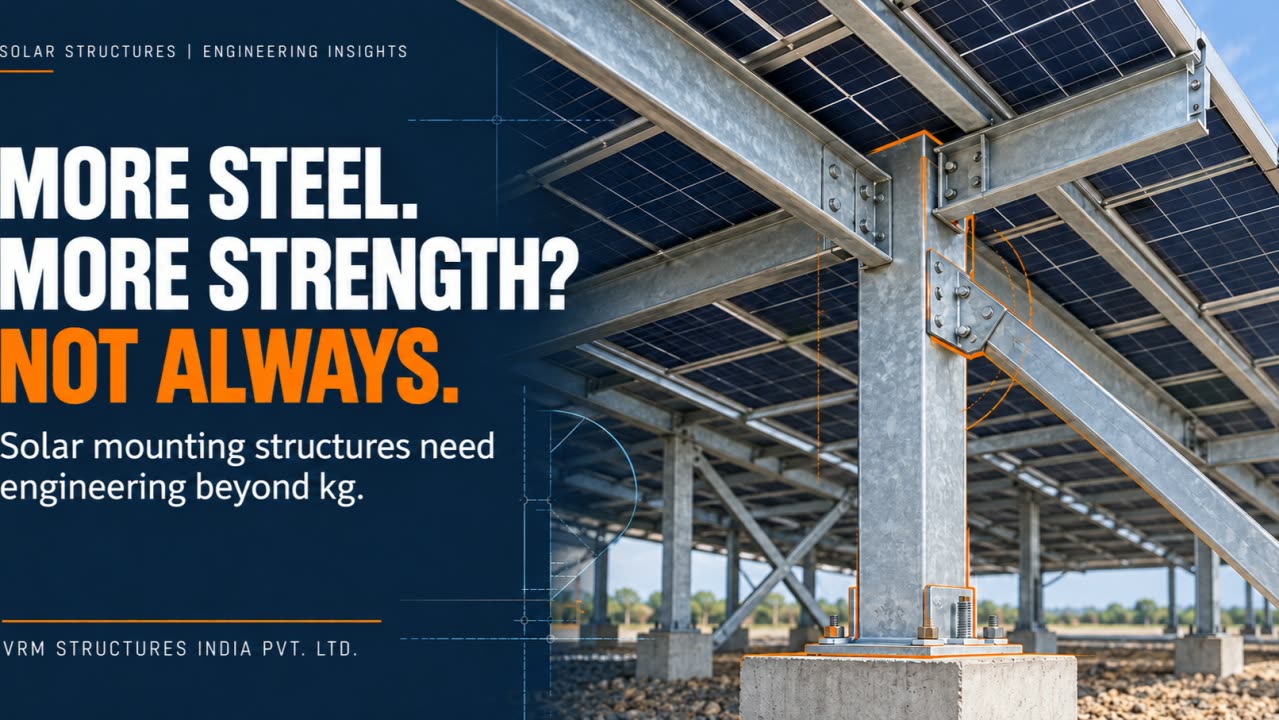
Two solar mounting structures can weigh the same—and perform very differently.
When comparing solar mounting structures, one question comes up frequently:
How many kilograms of steel per kW?
It is a useful question for estimating material quantity. But it cannot, by itself, establish structural strength.
Because steel quantity is only one part of the engineering.
A structure’s performance also depends on:
- Section geometry: Profile depth, shape and thickness influence how a member resists bending and buckling.
- Unsupported span: The distance between supports affects the forces and deflection in rafters and purlins.
- Bracing arrangement: Properly designed bracing helps control movement and transfer lateral forces.
- Connection design: Bolts, cleats, holes and plates must transfer the forces calculated for each connection.
- Anchoring: The load must travel safely into the roof or foundation.
- Site conditions: Location, exposure, installation height and array geometry influence wind loading.
Consider a simple example.
Two structures use the same total quantity of steel. One distributes it through suitable profiles, support spacing and connections. The other concentrates material in heavy members while leaving a critical connection or unsupported span inadequately designed.
Equal weight does not mean equal capacity.
The same principle applies to cost reduction. Reducing material through verified engineering can improve efficiency. Removing material without checking strength, stability, deflection and connections can introduce weaknesses.
Before approving a mounting structure, ask:
- What site conditions and loads were considered?
- What material grade and section dimensions were used?
- Are member spans and overhangs within the verified design?
- Have connections and anchors been checked?
- Does the mounting arrangement follow the module manufacturer’s requirements?
- Will the installed structure match the approved drawings?
A solar mounting structure is a complete load path—from the module connection to the roof or foundation.
Every link matters.
The better procurement question is:
How has this structure been verified for my project?
When comparing mounting-structure quotations, do you receive structural calculations—or only a material weight statement?
What carries more weight in your procurement decision: kg/kW, price/kW, or documented structural verification? Evaluate structures by engineering.
First published on LinkedIn. Join the discussion there.

Sign up to receive structure specifications.
By subscribing you agree to with our Privacy Policy and provide consent to receive updates from our company.
© 2026 VRM STRUCTURES INDIA PRIVATE LIMITED. All rights reserved.