Solar Mounting Structures: Higher Steel Strength Does Not Automatically Mean Less Deflection
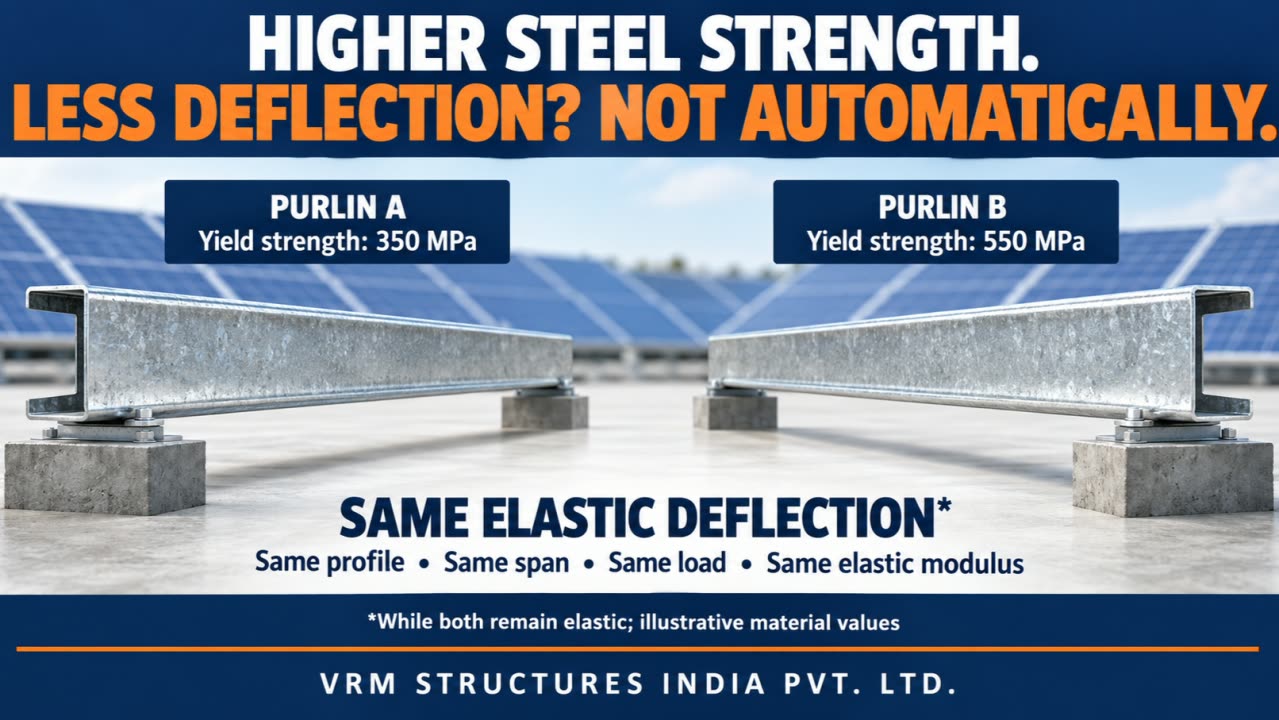
We have upgraded the steel grade. Will the structure bend less?
It is a reasonable question.
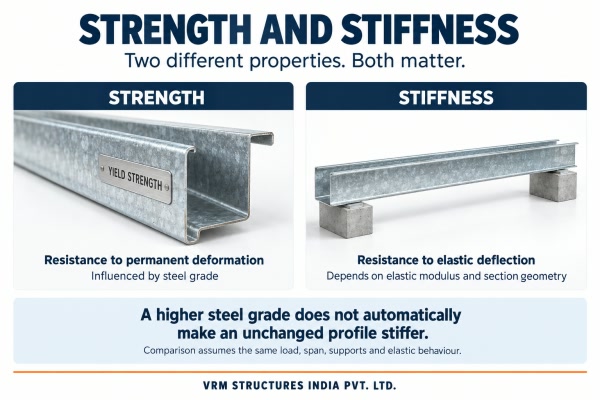
But higher yield strength and greater stiffness are different properties.
Understanding this difference matters when selecting steel for solar mounting structures.
Strength and Stiffness: What Is the Difference?
Yield strength describes the stress at which steel begins to undergo permanent deformation.
Stiffness describes how much a member deforms under load.
For a steel purlin, elastic bending stiffness depends on:
- The material’s modulus of elasticity.
- The section’s geometry and orientation.
Common structural carbon steels have broadly similar moduli of elasticity, even when their yield strengths differ.
Upgrading the grade can improve resistance to yielding without significantly changing elastic deflection.
An Illustrative Example: 350 MPa vs 550 MPa
Consider two purlins with:
- Identical section dimensions and thickness.
- Identical support spacing and orientation.
- Identical loading and restraint conditions.
The difference is the specified yield strength:
- Purlin A: 350 MPa
- Purlin B: 550 MPa
Assume both remain within their elastic range and have the same modulus of elasticity.
Their calculated elastic bending deflections will be approximately the same.
The 550 MPa steel has a higher yield-strength value, but it does not automatically make the unchanged section stiffer.
These are illustrative material values. The properties used in an actual design must match the relevant product specification and material documentation.
Does Higher-Strength Steel Offer Benefits?
Yes.
Where yielding governs, higher-strength steel can offer opportunities to improve capacity or optimise material use.
However, the complete member must still be checked for:
- Local and overall buckling.
- Deflection.
- Connection capacity.
- Applicable material and fabrication requirements.
A higher yield-strength value alone does not establish the capacity of the complete mounting system.
What If We Reduce Thickness?
Suppose a higher steel grade is selected and the profile thickness is reduced to save weight.
Resistance to yielding may still satisfy the design requirement.
But reducing thickness also changes section properties and can increase deflection or susceptibility to buckling.
The revised profile therefore needs fresh checks.
A material-grade upgrade does not justify an automatic thickness reduction.
How Can Deflection Be Reduced?
Depending on the structural arrangement, an engineer may consider:
- Increasing section depth.
- Selecting a more suitable profile.
- Reducing unsupported span.
- Revising member orientation.
- Providing appropriate restraint or additional supports.
The chosen solution should address the behaviour that governs the design.
What Should EPC Companies Ask?
When a supplier proposes higher-strength steel, ask:
Which design requirement does this improve—and have deflection, buckling and connections also been checked?
Review the material grade together with section dimensions, thickness, support spacing and structural calculations.
Steel grade is an important input.
It is one part of the engineering.
Higher strength can improve resistance to yielding. Stiffness still depends on material elasticity and section geometry.
When comparing solar mounting structures, do you review both strength and deflection—or only the steel grade?
First published on LinkedIn. Join the discussion there.

Sign up to receive structure specifications.
By subscribing you agree to with our Privacy Policy and provide consent to receive updates from our company.
© 2026 VRM STRUCTURES INDIA PRIVATE LIMITED. All rights reserved.